Posts

Longitarsus -Flea beetle
Image
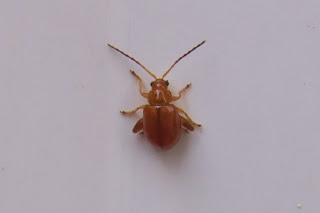
Got confirmation yesterday via iSpot of a tiny beetle I found crawling up the back door post earlier in the month. It could be of the genus Longitarsus, one of the many species of flea beetles. In fact there are about 700 species of Longitarsus. Many are very similar and experts are needed to identify them down to species level, and that is one thing I am not! The chap I found was less than 5mm in body length, orange metallic colouring, and the hind legs were enlarged. They are called flea beetles because of their escape mechanism of jumping vertically when disturbed.  Adult flea beetles overwinter in leaf litter, garden debris, or other sheltered places. As temperatures begin rising in spring, the adults emerge and locate suitable host plants on which they feed. Some flea beetles will feed on weeds until garden crops are available. In late spring, female flea beetles lay eggs in the soil around the base of host plants. Tiny larvae feed on roots and root hairs for abo...

The First Fieldfare of the Year - Turdus pilaris

Image
Saw the first fieldfare of this autumn in the garden this morning. the photos are not too good as it was early morning and the sky overcast. But it's definitely a fieldfare. It was feeding on the Rowan or Mountain Ash. Unusually it was on it's own, and I couldn't see any others around. Although we tend to get a little excited about seeing fieldfares in the UK, they are common in Europe. I was in Poznan, Poland earlier in the year, and the local park across the road was chock full of fieldfares feeding, squabbling and protecting their territories. The Welsh name for the Fieldfare is Socan Eira, meaning 'snow lover' or 'little snow gaiters'. Possibly a reference to the fact that they are winter visitors (1). In Polish it's Kwiczol (2), which is something similar to the call they make to my mind which is a harsh 'chack-chack'. It is a winter migrate from northern Europe, but there are records of breeding in the UK. They start to arrive in the...

Red Admiral - Vanessa atalanta

Image
A little bit of sunshine after a few wet days here in South Wales brought some beauty into the vegetable patch the other day.  This is the first time I can remember seeing a Red Admiral so late in the year, and I photographed this one feeding on one of the last plums left on the tree. The day before I also saw a speckled wood.   2013 has been a good year for butterflies, certainly better than the washout last year. I have certainly seen more butterflies this year, though that may be because Ive been looking!  The results from the Big Butterfly Count (1) this year showed a general increase in almost all the species. The red Admiral came in number 11 in the list with a 69% increase compared to the count in 2012. Species Grand total % change from 2012 1 Small White 154438 312 2 Large White 136944 335 3 Peacock 130796 3537 4 Meadow Brown 88547 -33 5 Gatekeeper 76935 15 ...

Owl Midge

Image
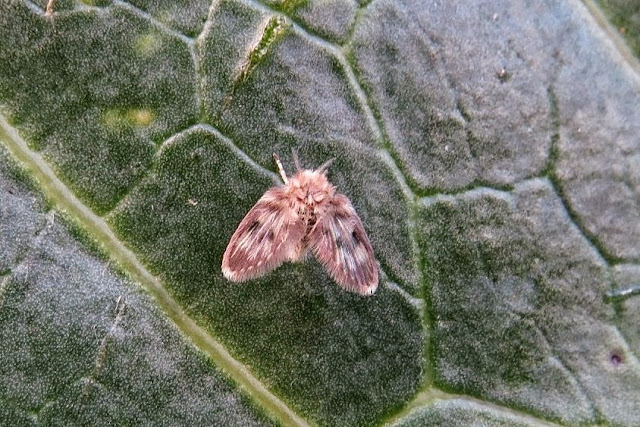
Discovered a fantastic and small midge in the vegetable garden the other day. At first I thought it was a micromoth, but after a great sea of bemussed serarching through my books I found out is is in fact a midge. There are 99 British species at least, with probably many more undiscovered yet. All very small with hairy, pointed wings. Although this is not a very good photograph, you can easily see how hairy it is. There is not a great deal of information available on the internet or anywhere I have looked so far. One thing I did find out is that all the sources agree that they are a very difficult group to identify without microscopes. So for now I'll have to be content with just an identification down to genus level. They have tiny eyes with few facets, and seem to rely more on their antennae than their eyes. The antennae are covered in sensitive hairs that pick up scents and vibrations. Often the adults can be found in huge swarms around sewage filter beds, and in such...

Garden Cross Spider - Araneus diadematus

Image
I watched this garden garden spider wrap up this honey bee for a number of minutes the other day in the garden. Another bee got caught in the web, but was able to escape just before the spider reached it. Then after a short pause it returned it it's original catch and continued to wrap it up a bit more. The word 'spider' derives from the Old English word 'spithra' and is related to the German 'spinne', both of which mean 'spinner'. This is never more true of the garden orb web spiders, and i n high summer and autumn the beautiful orb webs of the Garden Spider,  Araneus diadematus , can be found strung across paths, between shrubs and even in front of doors.  The web is spun overnight ready for the next day, and is often remade each day. The old web is consumed to retain important proteins necessary for the re-spinning process. The webs can be up to 40cm across, and are usually about 1-1.5m above ground. The garden spider spends most their ti...

Common Green Shield Bug - Palomena prasina

Image
I came across another shield bug today when I found this common green shield bug sitting on the the leaves of a phlox plant in the garden this afternoon. This is a large shield bug that is common throughout Britain, but less so in Scotland. There is one generation a year, with eggs laid in June and the larvae going through a series of instars, all slightly different in appearance. The barrel-shaped eggs are laid on the undersides of leaves. Both nymphs and adults feed on plant sap. The photograph below is of a 5th instar that I found in the garden in mid August, very near to the place I found the adult today. This developmental process from egg to adult through the series on instars is known as hemimetabolous development (1). Each of the instars resemble the adults but are wingless. Each instar stage has different colouration, and the final adult stage is reached in September. The adults then hibernate over winter and reemerge to breed in the late spring. The anatomy of the s...

Common plume - Emmelina monodactyla

Image
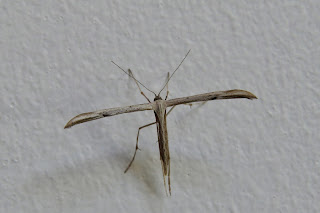
It seems to be my week for finding plume moths. As I was mowing the lawn this weekend, this chap kept on flying ahead of the mower. It turned out to be a Common plume. Although "Common" I still think that it is a beautiful moth. No necessarily marked with any major contrasting features, but the subtly of the markings are still intriguing in their own right. Emmelina monodactyla LINNAEUS, 1758 Superfamily - PTEROPHOROIDEA Family - PTEROPHORIDAE It has a couple of alternative common names along with Common Plume, it is also known as the T Moth and Morning Glory Plume Moth. The habit of rolling up its wings at rest in the T shape is reflected in it's latin name which describes the wing shape very clearly when the moth is at rest as its appears to only have one (mono) finger (dactyl) although this is because the lightly coloured brown wing is highly rolled up and there are actually more fingers with thin feathery hairs which look much like the wings of a bird. It h...